
When wildlife conservation is discussed in India, Pench Tiger Reserve holds a place of great pride among a few select national parks and tiger reserves. Spread across the border of Madhya Pradesh and Maharashtra, this dense forest region is not only a safe haven for tigers but has also become a living example of successful coexistence between humans and nature. Here, conservation is no longer confined to government efforts alone; it has grown stronger through the active partnership of local communities. The protection of tigers is not just the responsibility of the forest department anymore—it has become a shared commitment of the surrounding villages. This partnership is what makes Pench one of the most successful tiger reserves in the country.
Earlier, human–wildlife conflict was common, but today villagers consider tigers a treasured heritage of their forest. By linking rural communities with employment, forest-based livelihoods and eco-tourism, their trust in conservation has increased. Self-help groups, homestays, guides and handicrafts have connected protection with income. Villagers voluntarily share information about poaching, help in preventing forest fires, and take care of water sources for wildlife. In return, the administration ensures transparent systems of compensation, facilities and rehabilitation.
The example of Pench proves that when conservation becomes connected with people, forests remain safe and tigers roam fearlessly. This is the true model—where forests are saved and human lives also prosper.
Geographical and Historical Significance of Pench
Pench Tiger Reserve is named after the Pench River that flows through this region. The reserve spreads over nearly 750 square kilometers and is rich in teak, bamboo, tendu and mixed forests. The area is blessed with hills, valleys and water bodies, making it extremely rich in biodiversity.
This is the very jungle immortalized by the world-famous author Rudyard Kipling in his classic work The Jungle Book. From the story of Mowgli to the tigers, bears and deer of these forests, all remain vivid in human imagination even today.
A Unique Tiger Sculpture Spreading the Message of Environmental Conservation
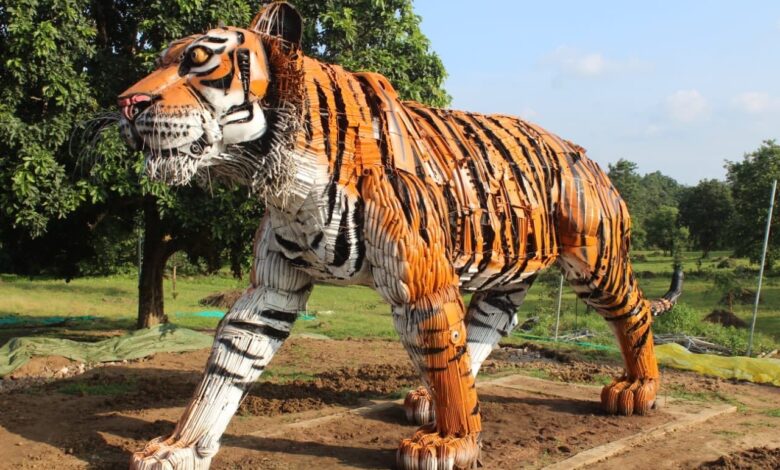
Following the Prime Minister’s Mission LiFE message and the principle of the three Rs—Reduce, Reuse and Recycle—a unique, world-class tiger sculpture has been created at Pench Tiger Reserve. This sculpture is made entirely from discarded iron scrap. Old bicycles, pipes, rusted metal sheets and other waste metal materials have been creatively reused.
Local artists from Seoni district shaped this grand artwork with their skill and imagination. The concept of this sculpture was inspired by the iron lion created under the ‘Make in India’ initiative, which was also made from scrap material.
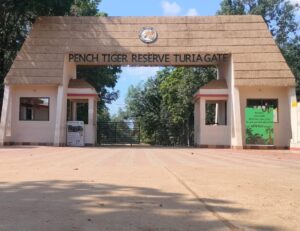
According to information available on the World Record Academy website, the world’s largest tiger statue earlier was in the state of Georgia, USA, with a height of 8 feet and a length of 14 feet. In contrast, the sculpture installed at the Khawasa tourism gate of Pench is 17 feet 6 inches high, 40 feet long and 8 feet wide, making it one of the largest scrap-made tiger sculptures in the world.
This sculpture not only conveys a powerful message of environmental protection but also highlights the importance of local art, self-reliance and recycling in an impressive way.
“Blanket Donation Campaign”: A Support Initiative During Winter
This year, Pench Tiger Reserve has launched a commendable welfare initiative called the “Blanket Donation Campaign.” This campaign is being conducted especially for the families living in the buffer zone of the reserve, who face severe cold and limited resources during winter.
The main objective of this initiative is to protect needy villagers, the elderly, children and working families from the harsh cold. With the combined efforts of the forest department, local administration, voluntary organizations and social workers, the campaign is being implemented effectively across the region. Blankets are collected through designated centers and distributed systematically among the needy.
This initiative goes beyond relief distribution; it also symbolizes cooperation, compassion and sensitivity between humans and nature. Pench Tiger Reserve, known for wildlife conservation, is now also becoming an inspiring example in the field of social responsibility. The “Blanket Donation Campaign” will not only provide warmth during winter but will also strengthen the spirit of humanity and cooperation.
A New Proof of Biodiversity in the Forests of Pench — The Black Panther
The sighting of a Black Panther (melanistic leopard) in Pench Tiger Reserve is considered an extremely rare and historic event across India. Normally, a leopard is known for its yellow coat with black spots. However, in some leopards, a special natural genetic change occurs, scientifically known as “melanism.” In this condition, the production of the dark pigment (melanin) increases significantly in the skin, making the body appear completely black instead of yellow with spots. Though, on closer observation, faint spots can still be seen.
When a leopard appears in this black form, it is commonly called a “Black Panther.” It is not a separate species, but only a natural color variation that makes it rare and fascinating.
In India, Black Panthers are mostly limited to the Western Ghats and a few dense forest regions. Therefore, its appearance in a place like Pench Tiger Reserve in Madhya Pradesh is not only astonishing but also confirms the rich biodiversity and successful conservation of the area. The dense forests of Pench, availability of prey, peaceful environment and secure habitat provide ideal conditions for this rare animal.
The Black Panther being captured on camera traps is also extremely important for wildlife experts and researchers. This discovery opens new doors for scientific studies on the ecological balance and biodiversity of the region. It also increases public awareness towards wildlife conservation and strengthens the international identity of Pench Tiger Reserve.
Today, conservation work at Pench is supported by modern technologies. Drones, camera traps, radio collars and geo-tagging are used to monitor wildlife movements. Forest personnel receive advanced training, and the deployment of a special Tiger Protection Force has greatly reduced poaching.
Community Participation in Conservation
The greatest foundation of Pench Tiger Reserve’s success has been the participation of local communities. Earlier, villagers depended heavily on forests for fuel, wood, fodder and other needs, increasing pressure on forest resources.
The forest department turned this challenge into an opportunity by adopting a “community-based conservation” strategy. Villagers were linked with Forest Protection Committees, Eco-Development Committees and Wildlife Mitra (Friends of Wildlife) schemes. Today, the same villagers actively participate in patrolling, fire prevention and anti-poaching drives.
A Stronghold of Tiger Conservation
There was a time when poaching, deforestation and human interference caused a serious decline in the tiger population of Pench. However, over the last two decades, strict protection, scientific management and community participation have led to a continuous increase in the tiger population.
Today, Pench is not only a safe habitat for tigers but also shelters leopards, sloth bears, spotted deer, sambar, nilgai, wild dogs and hundreds of species of birds.
Balancing Livelihood and Conservation
Conservation becomes sustainable only when the economic security of local people is also ensured. With this vision, several alternative livelihood opportunities have been developed in the Pench region. Through eco-tourism, hundreds of youth have found employment as guides, drivers, resort staff and nature interpreters.
Women have been linked with self-help groups and trained in handicrafts, bamboo craft, organic manure, leaf-plate making and preparation of local food products. This has strengthened women empowerment and increased family incomes. As a result, dependence on forests decreased and people began to see conservation as connected to their own future.
Relocation and Rehabilitation: A Sensitive Chapter
For conservation purposes, some villages were relocated from the core area. This process is often controversial, but in Pench it was completed with sensitivity and a humane approach. The relocated families were provided with permanent houses, cultivable land, electricity, water, schools, roads and healthcare facilities. This improved their standard of living and helped restore the forest to its natural state. That is why compared to other regions, there was less resistance to relocation here.
Co-existence of Humans and Nature
Pench Tiger Reserve proves that conservation is made possible not only by laws, but by trust, participation and sensitivity. When local communities begin to see themselves as a part of the forest, they become its strongest protectors.
Today, Pench Tiger Reserve has become an inspiring model for the entire nation, where conservation and development move hand in hand. It demonstrates that if local society is included, forests can remain safe and livelihoods can also flourish. The roar of tigers, lush green forests and self-reliant villages—this is the true identity of Pench. Leaving a secure natural heritage for future generations remains the greatest objective of this conservation journey.