AIIMS Bhopal and Hindustan Copper Join Hands to Improve Health Services in Tribal Areas
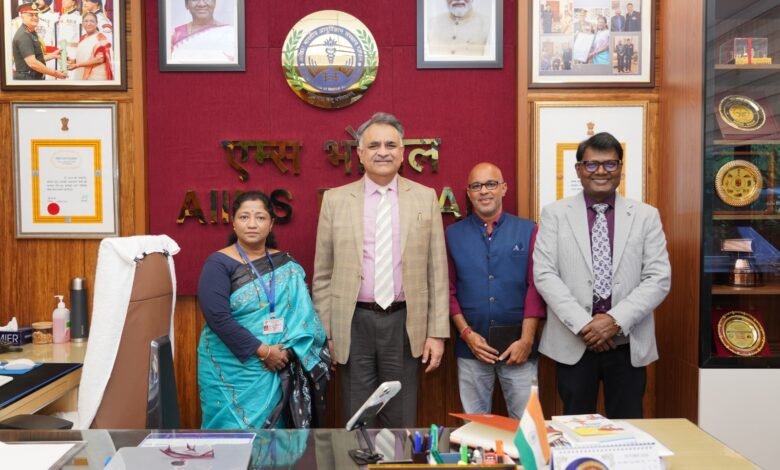
AIIMS Bhopal and the Malajkhand Copper Project of Hindustan Copper Limited met to improve health services in the tribal and mining-affected areas of Balaghat.
• Monthly specialist health camps have been proposed in mining-affected villages and nearby tribal areas.
• Training and technical guidance for healthcare staff at the Malajkhand Copper Project Hospital, and telemedicine consultations through platforms such as e-Sanjeevani, were discussed.
• A scientific, evidence-based study on the possible health effects of copper exposure has been proposed.
• A phased plan will be prepared to develop the Centre for Tribal Health and Research at Malajkhand.
AIIMS Bhopal and the Malajkhand Copper Project of Hindustan Copper Limited have come together to bring better healthcare to people in the tribal and mining-affected areas of Balaghat district. At the meeting between the two institutions, monthly specialist health camps, telemedicine consultations, training for healthcare workers and research were discussed. It was also agreed to develop the Centre for Tribal Health and Research at Malajkhand in phases. The initiatives are expected to bring specialist doctors’ services closer to people living in remote villages.
The meeting was chaired by Lt Gen (Dr) Narendra Kotwal, Executive Director, AIIMS Bhopal. Prof. Surya Bali, Nodal Officer of the Centre for Tribal Health and Research (CTHR), represented AIIMS Bhopal. Dr. Medha Dave, Deputy General Manager (Medical & Health Services), and Mr. Himanshu Sekhar Panigrahi, Chief Manager (CSR), took part on behalf of Hindustan Copper Limited.
Several important proposals were discussed. AIIMS Bhopal will explore the possibility of providing training and technical guidance to healthcare workers at the Malajkhand Copper Project Hospital. It was also proposed that the hospital team and AIIMS Bhopal specialists will jointly hold health camps every month in mining-affected villages and nearby tribal areas.
A scientific, evidence-based study was also proposed on the possible effects of copper exposure on the health of local people. Depending on need, it may include epidemiological study (an investigation into the causes and patterns of disease spread in an area), environmental assessment and clinical evaluation.
The possibility of arranging consultations with AIIMS Bhopal specialists through telemedicine platforms such as e-Sanjeevani was also discussed, so that patients in the region can easily access specialist services.
A phased action plan will be prepared to develop the Centre for Tribal Health and Research at Malajkhand as a hub for tribal health services, research, training and community outreach. It will also focus on coordination with the relevant government departments. Both institutions stressed the need to formalise their cooperation and ensure continued technical guidance and institutional support.
At the close of the meeting, both institutions expressed their commitment to work together for the health and well-being of the tribal and mining-affected communities of Balaghat. The proposed activities will be taken forward through mutual coordination and a phased action plan.