Building Bharat Sampaark National Startup Contest Crowns Its National Champions • India’s Next Infrastructure Innovations Have a Name
Vijayanagar, Karnataka | 24 August 2026: India's infrastructure future did not arrive on paper this August. At the Building Bharat Sampaark National Startup Contest, it arrived in the form of 14 finalist teams - India's sharpest young civil engineers - ready to prove that an idea born in a classroom can survive the real world. When the contest concluded, one team stood above the rest.
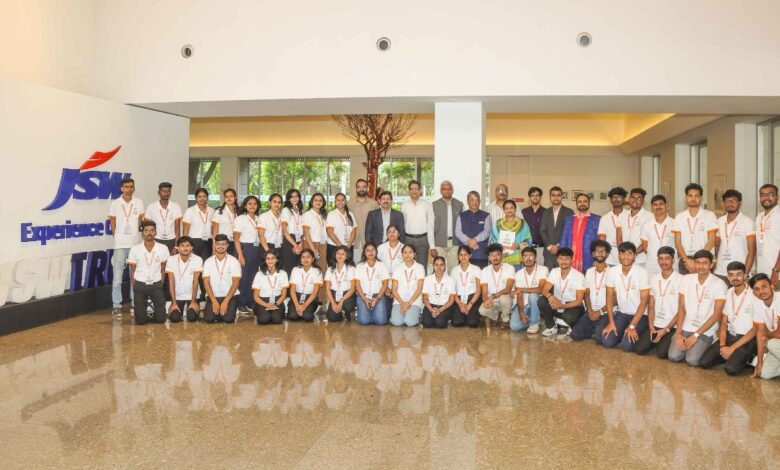
Team Vaibhav, comprising Vaibhav Purshotham and Vishnu Manikandan from MGR University, Chennai, for developing a safety monitoring system, and Team Symmetris Tech, comprising Prathyusha Krishna VP, Lakshmi Priya B, Meenakshy G and Manha Muneez from Muthoot Institute of Technology & Science, Ernakulam, Kerala, for innovating Safe Track, were declared the national winners of the Building Bharat Sampaark National Startup Contest, held at the JSW Vidyanagar Township in Toranagallu, Karnataka.
These teams were not picked from a single competition. They are the standout minds to emerge from the entire Building Bharat Sampaark innovation journey—forged across boot camps and hackathons spanning IIT Gandhinagar, IIT Kanpur and IIT Madras. Every idea they carried had already survived rounds of mentorship, challenge and expert scrutiny. For the National Startup Contest, they took those ideas to JSW Vijayanagar-one of India’s largest integrated steel townships-where ideas face their toughest test: industry itself.
For most of their academic lives, India’s civil engineering students have solved infrastructure problems in classrooms and exam halls – insulated from the scale and complexity of the real world. The National Startup Contest changed that. It was not a campus event, but a test of whether an idea first sparked in a college laboratory, and sharpened through the Building Bharat Sampaark Innovation Boot Camp in Civil Engineering, can earn its place in the world it is meant to change.
The involvement of the Atal Innovation Mission (AIM), NITI Aayog gives these innovations structured access to pre-incubation, mentoring and startup routes – a clear signal that civil engineering innovation is not peripheral to Viksit Bharat 2047, but central to it.
“India is rapidly advancing in road networks, large-scale infrastructure, logistics, and urban development. Yet, challenges around road safety, building safety, accessibility, sustainable construction, and infrastructure in rural and difficult terrains remain. The next phase of India’s infrastructure growth must be driven by innovation. We need to create an ecosystem that enables civil engineers to experiment, pilot, validate, and deploy breakthrough technologies and sustainable solutions, moving beyond conventional approaches to build safer, smarter, more resilient, and inclusive infrastructure for every part of the country.”
– Shri Prateek Deshmukh, Program Lead, Atal Innovation Mission
For the Association of Infrastructure Industry (India), the contest represents something more fundamental than a milestone – a new proposition about what India’s civil engineering talent is capable of.
“The question is no longer whether India’s young civil engineers have ideas. They clearly do. The harder question is whether we can build the platforms, the mentorship and the industry pathways that allow those ideas to survive beyond a competition room. We want young engineers to move from identifying a problem to building a solution, and ultimately from being participants to becoming innovators, founders and builders. That journey is not separate from Viksit Bharat 2047 it is the prerequisite for it.”
– Dr. Rajaneesh Dasgupta, Trustee & Director General, Association of Infrastructure Industry (India) | National Director, Building Bharat Sampaark
“At Vijayanagar, we believe ideas gain real value when they are tested against real-world challenges. Building for India requires ideas that can work at scale and stand up to these challenges. Bringing 14 young teams into an operating industrial environment gave them an opportunity to see the scale, complexity and practical demands of infrastructure and industry first-hand. That is what makes Building Bharat Sampaark meaningful—creating a bridge between innovative ideas and the realities of building for India’s future. We are proud that Vijayanagar could provide that journey.”
– Shri PK Murugan, President, JSW Steel Vijayanagar & Salem Works
Hosting the contest at JSW Vijayanagar was deliberate. The teams walked through one of India’s most advanced industrial ecosystems – steel and cement manufacturing, mining and ore operations, automation and large-scale construction technology – witnessing first-hand the sustainability and environmental standards that a modern infrastructure enterprise runs on. It was industry as classroom. That exposure was then paired with a visit to the ruins and river ghats of Hampi, a UNESCO World Heritage Site and a masterclass in ancient Indian engineering – water management, structural design and material innovation achieved without modern tools. The pairing was intentional: a generation asked to build India’s future must first understand both the industry that will build it and the civilisational depth of what India has already built.
For the winning team, the title is not a finish line but a starting point – the beginning of the pathway from prize to prototype to real-world solution. That, ultimately, is what the Building Bharat Sampaark National Startup Contest was built to make possible.